Skip to content

Hazine

For Researchers of the Diverse Islamic Worlds

  • Archives
    • Americas
      • Jesuit Archives & Research Center, Saint Louis (MO)
        • The Presbyterian Historical Society
          • East Asia
            • National Archives of Japan
    • Europe
      • Archivo General de Simancas
      • Centre des Archives Diplomatiques de Nantes (CADN)
      • Central Historical Archive of Georgia
      • Bosniak Institute
      • Historical Archive of Macedonia (Thessaloniki)
      • The National Archives (United Kingdom)
      • National Library of Bulgaria
      • Ottoman State Archives
    • Middle East and North Africa
      • The American Research Center in Egypt’s (ARCE) Conservation Archive
      • The American Jewish Joint Distribution Committee Archives (Jerusalem)
      • Archives du Maroc
      • Central Zionist Archive
      • Dar al-Mahfuzat al-ʿUmumiyya (Cairo)
      • The Museum of Textbooks (Jordan)
      • Red Crescent Archives (Turkey)
      • Topkapı Palace Museum
    • Digital Archives
      • A Short Introduction to Kurdish Online Resources
      • دليل المصادر البصرية على الإنترنت لدراسات المشرق والمغرب العربيين والدراسات الإسلامية
      • Archives and Libraries for the Study of Afghanistan
      • Online Archives, Digitized Collections and Resources for Middle East, North Africa, and Islamic(ate) Studies
      • A Guide to Online Visual Sources in Middle East, North Africa, and Islamic Studies
      • MENADoc
      • Researching Modern Egypt Online
      • Tahrir Documents
      • Venetian State Archives Online
      • Women’s Worlds in Qajar Iran
  • Libraries
    • Europe
      • The Biblioteca Apostolica Vaticana
      • The British Library for Newcomers: A Step-by-Step Visual Guide
      • Bosniak Institute
      • Chester Beatty Library
      • Gazi Husrev Begova Library
      • Institute for Oriental Studies (Sarajevo)
      • Leiden University
      • John Rylands Library
      • National Library of Bulgaria
    • Middle East
      • Al-Imam al-Hakim Public Library
      • Maktabat al-Azhar (Cairo)
      • Orient-Institut Istanbul
      • The Cairo Agricultural Museum and Library
      • İSAM
      • Malek National Library and Museum
      • Milli Kütüphane
      • National Library in Amman
      • Süleymaniye Library
      • Topkapı Palace Museum
      • National Library in Amman
      • Jafet Library, the American University of Beirut (AUB)
      • A Short Research Guide to Egypt
  • Essays
    • Fetishizing Egypt: An Exhibition Review of Art D’Égypte’s “Cairo International Art District” (2021)
    • At the Record Store: Interrogating World Music
    • Singing Back to Wax: Early Arabic Recordings Revisited
    • Introducing Our Series on “Art in the Digital Sphere” نقدم لكم سلسلة الفن والمجال الرقمي
      • العين صابتني والفن الرقمي أغواني: مدخل للفن الرقمي من خلال فنان رقمي
    • The Limits of Palestinian Art: An Exhibition Review of “If only this mountain between us could be ground to dust”
    • الأرشفة التحرّرية في الأفضية المُتاحة
    • The Pen’s Screech: Muslim Spiritual Practice of Arabic Calligraphy
    • هل المصدر المفتوح مفتوح بالفعل؟ – قصة مصورة
    • What is “Open Access,” Really? – A Comic
    • Inclusive Pedagogy Roundtable
      • On Rebellious Teaching: Lessons from a Black Feminist Gallery Teacher
      • The Community College Mission: How Inclusive Pedagogy Emerged from the 1947 Truman Report and the Open Door to Higher Education
      • Crafting the Syllabus: Representation, Expertise, and Student Learning
    • أثر التغريب على تصميم الخطوط الطباعية العربية
    • In Alienation: Arabic Typographic Matchmaking
    • Archivy (n. ~ The discipline of archives) *: everything that’s already been said
    • An Informal Guide to Fuat Sezgin’s Geschichte Des Arabischens Schriftums
    • 11 Digitized Collections for Middle East Historians
    • Google Ngram: an intro for historians
    • Researching in Digitized Libraries
  • Resources
    • Archives of Recorded Sound from the South and East Mediterranean: A Guide for Researchers
      • Resources for Learning Non-Arabic Sudanese Languages
    • A Short Introduction to Kurdish Online Resources
    • Archives and Libraries for the Study of Afghanistan
    • الأرشيفات على الإنترنت والمجموعات والموارد الرقمية لدراسات المشرق والمغرب والدراسات الإسلامية
    • Online Archives, Digitized Collections and Resources for Middle East, North Africa, and Islamic(ate) Studies
    • Podcasts on the Middle East, North Africa, and Islamic(ate) Studies
    • دليل المصادر البصرية على الإنترنت لدراسات المشرق والمغرب العربيين والدراسات الإسلامية
    • A Guide to Online Visual Sources in Middle East, North Africa, and Islamic Studies
    • Blogs You Should Be Adding to Your Bookmarks
    • Using the AlKindi Catalogue as a Bibliographic Tool for Islamic Studies (and an Introduction to Cataloguing Standards)
    • A Guide to Annual Meetings: How to Submit Papers, Panels and more!
    • Pre-1928 Ottoman Turkish Literary Periodicals
      • Pre-1928 Ottoman Turkish Literary Periodicals: Tanzimat (1839-1876)
      • Pre-1928 Ottoman Turkish Literary Periodicals: The Hamidian Period (1876-1908)
      • Pre-1928 Ottoman Turkish Literary Periodicals: The Second Constitutional Period (1908-1923)
      • Pre-1928 Ottoman Turkish Literary Periodicals: The War of Independence and the Turkish Republic (1919-1928)
    • 11 Digitized Collections for Middle East Historians
    • Open-access Digitized Archival Materials
    • Open-Access Digitized Islamic Manuscripts
    • al-hakawati.net, a Virtual Public Library of Arab and Islamic Heritage
  • Interviews
    • Translating Mughal Paintings into Scents: An Interview with the Curators of Bagh-e Hind, Bharti Lalwani and Nicolas Roth
    • The Arabic Script in Nigerian Hands: Ustadh Yushaa Abdullah on Arabic Calligraphy Education in West Africa
    • Disrupting Dynamics of Imitation: An Interview with the Founders of Hajar Press
    • Grounding Theory in Material Objects: An Interview with Dr. Marianna Shreve Simpson
    • Walid Ghali, Aga Khan Library
    • Arabic has a Visual Voice: Bahia Shehab on the Arabic Letter, TYPE Lab and the Visual Encyclopedia of Arabic Letters
    • Dr Kelly Tuttle and Manuscripts of the Muslim World
    • Islamic Art as Inspiration: Stephen Serpell
    • Guy Burak
    • Mehmet Kentel and Akın Özarslantürk
  • About
    • Donate
    • Submission guidelines
    • Contributors
    • Our Friends
    • Testimonials
    • Our Layout
  • EnglishEnglish
    • العربيةالعربية
    • EnglishEnglish
Posted on April 19, 2021August 12, 2021 by hazineeditor

Introducing Hazine’s New Visual Identity (Including Our Logo)!

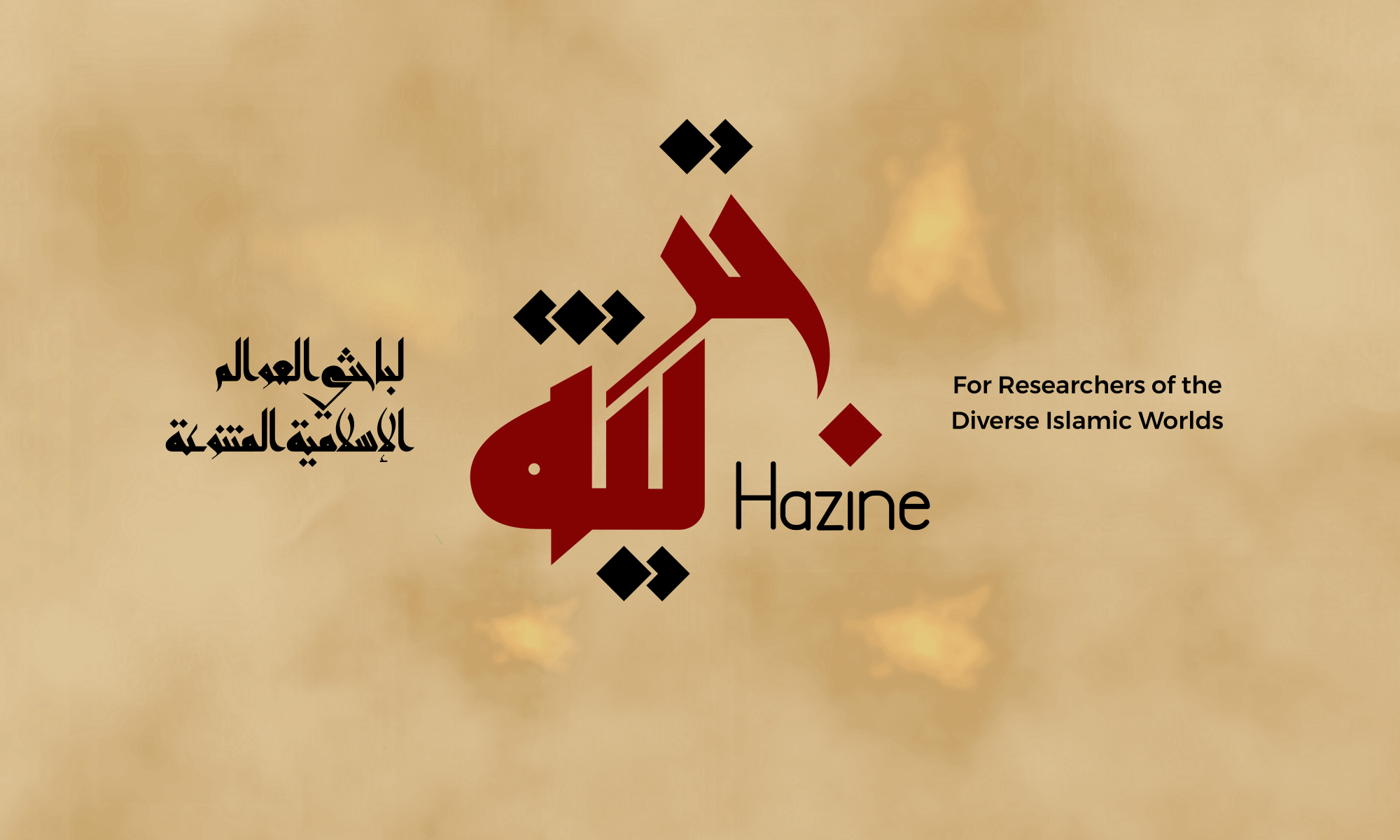
The Arabic script in Hazine's logo (“خزينة”) is displayed in the Qairouany Kufic script. The body is in blood-red while the dots are in black. The letters kha' and za' are placed above the letters ya', nun and ta' marbuta. The dots of the letters intersect. “Hazine” is written in black to the right of the Arabic in a smaller size using a simple and thin Latin script that is rounded at the edges. The background is a beige parchment texture with yellow-orange splotches.
Hazine’s new logo

We are proud to release our new logo. Designed by Marwa Gadallah, Hazine’s Art Editor, alongside the rest of the team, it is the product of over six months of brainstorming and drafts. But it is also reflective of all of the changes that have been going on at Hazine over the last year. For one thing, we’ve been doing more Arabic content. We’re running more guides and resources on researching various regions and peoples from the Kurds to Afghanistan. We’re publishing essays and criticism on pedagogy, museums, archives, typography and more. And as we become more criticism-oriented, you’ll see more comics, more photo essays, things that break moulds.

Our logo touches on different aspects of this shift. It is part of a long calligraphic and visual history. As Hazine seeks to be a platform that is more representative of the histories and sensibilities in the Islamic worlds and its multitudes, it was important that the visual identity we developed reflected this very purpose. Gadallah was influenced by traditional Arabic scripts and is also trained in several Arabic calligraphic forms (and counting!) She was learning the Qairouany Kufic script from the Egyptian master Ustadh Salah Abd Elkhalek when this project began. Thus, the main icon in the logo, an Arabic-script representation of the term “Hazine”  (“خزينة”), or treasury, is written in this script, which was developed in the fifth year of Al-Hijrah and used to write a single mushaf in 410 H in Kairouan, Tunisia. Ustadh Salah had travelled from Egypt to Tunisia and learned it from the Tunisian master Ustadh Amer Benjeddou, who is responsible for bringing the Qairouany Kufic script back into the classroom. This historical master-to-student process of transmitting the Islamic arts is what makes this particular logo design special: we can trace the line of students to teachers, teachers to students. 

A two-page manuscript displays parts of Qur'anic verses (with no dots) with five lines on each page in a brown-yellow Qairouany Kufic script. The manuscript is beige and contains brown-orange stains.
Bifolium from the “Nurse’s Qur’an” (Mushaf al-Hadina), written in Kufic Qairouany, ca. A.H. 410/ A.D. 1019–20. Item Number 2007.191. Metropolitan Museum of Art. 

While working on the logo, sketching the word “Hazine” in Qairouany Kufic did not take much time. However, it was challenging to balance the various elements of the logo. We played with the overall shape until we decided on the final triangular structure, as well as the dots. Another challenge involved deciding how the Arabic script would look in relation to the Latin script. At first, we sought to create two equally balanced logos that would make up a bilingual logo and then we realized that the Arabic script could serve as a main legible icon whilst the Latin would go alongside the main Arabic icon. Thus, we got rid of the equal balance between the Arabic and Latin scripts. 

There are three digital sketches of the word “Hazine” in Arabic with no dots on top of each other; top: Qairouany Kufic script, middle: script inspired by an early Kufic script, bottom: Al-Qandusi script.
Early digital logo sketches, top: Qairouany Kufic script, middle: inspired by an early Kufic script, bottom: Al-Qandusi script.

Hazine is also very much dedicated to manuscripts of the Islamic worlds and the many peoples it encompasses. So, the other visual elements of the logo, including the colors and the background, were inspired by the manuscript traditions. The text is in blood-red and black, similar to many manuscripts of the Arabic language. Black is used for the body-script and red is often added later for dots; we switched this up because while we want to pay homage to manuscript culture, we’re not necessarily part of just manuscript culture. The background is made to look like paper, produced out of rags, linen and rope; the splotches on the beige background are intentional: they convey water damage. With the logo, we are beginning a visual identity that will be found in various parts of the website, our marketing tools, and our publications themselves. It was important for us to use a touchstone that felt universal, but also, that we could apply to different projects. The Arabic-script manuscript has a universality to it that, even today, we could emulate.

The Arabic script in Hazine's logo (“خزينة”) is displayed in the Qairouany Kufic script with only one dot above the letter kha’. The body is in blood-red while the dot is in gold. The word forms a pyramid along with the Latin-script version, which is written to the right of the Arabic in blood-red and in a smaller size using a simple and thin Latin script that is rounded at the edges.
Logo draft, getting closer to the final pyramid shape

We also updated our tagline. “A Guide to Researching the Middle East and Beyond” isn’t simply what we’re doing anymore. Frankly, the term ‘ Middle East’ isn’t appropriate. Additionally, we don’t guide: we converse, even in our archive reviews. Instead, we are dedicating ourselves: “For the Researchers of the Diverse Islamic Worlds.” Worlds exist within worlds and we take “Islamic” to mean anywhere Islam has a presence. We’re not the only ones to do so: Medieval and Early Modern Orients (MEMOs) uses “Islamic Worlds,” too. Our new tagline doesn’t mean we cover Islam only. That’s why we need “diverse” in there. 

The Arabic script in Hazine's logo (“خزينة”) is displayed in the Qairouany Kufic script. The body is in red while the dots are in black. The letters kha' and za' are placed above the letters ya', nun and ta' marbuta. The dots of the letters intersect. “Hazine” is written in black to the right of the Arabic in a smaller size using a simple and thin Latin script that is rounded at the edges.
Hazine’s new logo

We also want to note that we used an open source program (Inkscape) while building the logo. If you’ve seen our content on open-access materials –and we currently have a call for pitches for pieces on open access– you know how we feel about accessibility.

Maybe one day the website will expand again and we’ll need to rethink our logo, our tagline. But for now, we are happy with this embodiment, we are proud of it, and at least, with the Arabic-script representation of our publication’s name, no one will ask us why we’re named after Arabic for “sad”. 

Share this:

  • Facebook
  • Twitter
  • Pocket
  • Email
  • Print
  • More
  • LinkedIn
  • Reddit
  • Tumblr
  • Pinterest
Categoriesabout TagsAbout Us, Arabic Calligraphy, Arabic script, Calligraphy, Logo

Post navigation

Previous PostPrevious Resources for Learning Non-Arabic Sudanese Languages
Next PostNext The Pen’s Screech: Muslim Spiritual Practice of Arabic Calligraphy

Search

Follow Hazine on Social Media

  • Facebook
  • Twitter

Subscribe to Hazine via Email

Enter your email address to subscribe to Hazine and receive notifications of new posts by email.

Join 694 other subscribers

Top Posts & Pages

  • Ottoman State Archives
    Ottoman State Archives
  • The British Library for Newcomers: A Step-by-Step Visual Guide
    The British Library for Newcomers: A Step-by-Step Visual Guide
  • Süleymaniye Library
    Süleymaniye Library
  • Topkapı Palace Museum
    Topkapı Palace Museum
  • Online Archives, Digitized Collections and Resources for Middle East, North Africa, and Islamic(ate) Studies
    Online Archives, Digitized Collections and Resources for Middle East, North Africa, and Islamic(ate) Studies
  • Whose Modernism? An Exhibition Review of Mohamed ElShahed’s Cairo Modern
    Whose Modernism? An Exhibition Review of Mohamed ElShahed’s Cairo Modern
  • Historical Archive of Macedonia (Thessaloniki)
    Historical Archive of Macedonia (Thessaloniki)
  • About
    About
  • Open-Access Digitized Islamic Manuscripts
    Open-Access Digitized Islamic Manuscripts
  • Women's Worlds in Qajar Iran
    Women's Worlds in Qajar Iran

Tags

  • 20th Century
  • Arabic
  • Archive
  • Archives
  • Art
  • Cairo
  • Calligraphy
  • Codicology
  • Court Records
  • Culture
  • digital
  • Digital Humanities
  • Digitized
  • Documents
  • Early Modern
  • Egypt
  • essay
  • Interview
  • Iran
  • Iranian History
  • Islam
  • Islamic
  • islamic studies
  • Istanbul
  • Lebanon
  • Libraries
  • Library
  • Magazines
  • Manuscripts
  • Medieval
  • Middle East
  • middle Eastern
  • Modern
  • newspapers
  • north africa
  • Online Archives
  • open access
  • Ottoman Empire
  • Periodicals
  • Persian
  • photographs
  • Printed Books
  • Sarajevo
  • Turkey
  • Turkish

This work is licensed under a Creative Commons Attribution-NonCommercial 4.0 International License.

  • Archives
  • Libraries
  • Essays
  • Resources
  • Interviews
  • About
  • EnglishEnglish
Proudly powered by WordPress